

Compliance Brief | November 2026
IRS Updates FAQs on Medical Expenses Related to Nutrition, Wellness, and General Health
The Internal Revenue Service (IRS) has updated its frequently asked questions (FAQs) addressing which nutrition, wellness, and general health expenses qualify for tax-favored treatment under health savings accounts (HSAs), health flexible spending arrangements (FSAs), health reimbursement arrangements (HRAs), and Archer medical savings accounts (MSAs).
The FAQs, originally released in March 2023, were updated on September 23, 2026, to address the eligibility of wearable health-tracking devices. The guidance helps employers, plan administrators, and employees distinguish between expenses incurred for medical care and those intended primarily to promote general health.
What Expenses Qualify?
Under Internal Revenue Code Section 213(d), eligible medical expenses generally include costs associated with diagnosing, treating, mitigating, or preventing a disease or affecting a structure or function of the body. Expenses that are merely beneficial to general health generally do not qualify.
The IRS FAQs provide several examples:
- Nutritional counseling and weight-loss programs: Eligible when used to treat a specific disease diagnosed by a physician, such as obesity, diabetes, or hypertension. Programs intended solely to improve general health or appearance do not qualify.
- Gym memberships: Generally ineligible unless purchased for the sole purpose of treating a physician‑diagnosed disease or affecting a structure or function of the body, such as through prescribed physical therapy.
- Nutritional supplements: Eligible when recommended by a medical practitioner to treat a specific medical condition diagnosed by a physician. Supplements taken for general wellness do not qualify.
- Special foods and beverages: May qualify when they do not satisfy normal nutritional needs, treat or alleviate an illness, and are substantiated by a physician. Only the additional cost above ordinary food is eligible.
- Mental health therapy: Eligible when provided to treat a disease, including a diagnosed mental health condition. General marital counseling does not qualify.
New Guidance on Wearable Health Devices
The September 2026 update adds guidance on wearable devices, including smartwatches, fitness trackers, rings, patches, and sensors that monitor health-related information.
The IRS explains that eligibility depends on the device’s primary purpose and how it is used. A wearable device qualifies as a medical expense when the individual purchases and uses it primarily to assist in the diagnosis, cure, mitigation, treatment, or prevention of a specific disease, based on all the facts and circumstances. However, a device purchased primarily for general fitness, sleep tracking, or wellness monitoring does not qualify simply because it collects health information.
Relevant factors include a medical practitioner’s recommendation, the individual’s diagnosis or risk factors, and how the collected information is used to manage a medical condition. Related accessories and software subscriptions must also primarily serve the qualifying medical purpose to be eligible.
Employer Action Items
- Employers sponsoring HSAs, health FSAs, or HRAs should review the updated FAQs and coordinate with their plan administrators to ensure reimbursement practices reflect IRS requirements.
- Employers may also consider updating employee communications to clarify that wellness-related purchases are not automatically eligible for tax-favored reimbursement. Appropriate documentation may be necessary to establish that an expense serves a qualifying medical purpose.
DOL Finalizes Pharmacy Benefit Manager Transparency Rule
On October 29, 2026, the U.S. Department of Labor (DOL) announced a final rule requiring pharmacy benefit managers (PBMs) and certain affiliated brokers and consultants to disclose fees and compensation associated with services provided to large employers’ self-insured group health plans. The final rule takes effect 60 days after publication in the Federal Register. Its requirements apply to plan years beginning on or after July 1, 2027.
The rule is intended to give plan fiduciaries greater visibility into PBM compensation arrangements, helping employers evaluate prescription drug costs, assess service provider fees, and negotiate contracts more effectively.
What Does the Final Rule Require?
PBMs serve as intermediaries between health plans, drug manufacturers, and pharmacies. Their compensation arrangements can be complex, making it difficult for employers to determine the full cost of prescription drug benefits.
The final rule requires disclosures that include, among other required information:
- Manufacturer rebates and payments: Rebates and other compensation PBMs receive from drug manufacturers.
- Prescription drug pricing differences: Compensation earned when a health plan pays more for a prescription drug than the PBM reimburses the pharmacy.
- Pharmacy recoupments: Payments PBMs recover from pharmacies in connection with prescriptions dispensed to plan participants.
The rule also gives plan fiduciaries the ability to audit the accuracy of PBM disclosures and provides a conditional administrative exemption for responsible plan fiduciaries when a covered service provider fails to meet its disclosure obligations. Fiduciaries must take specified steps to qualify for that relief. Covered service providers must provide initial disclosures reasonably in advance of entering into, extending, or renewing a contract, followed by ongoing disclosures no later than 30 calendar days after each semiannual period. Plans may request quarterly disclosures.
These requirements are designed to help fiduciaries assess whether compensation paid to PBMs is reasonable under the Employee Retirement Income Security Act (ERISA).
Potential Impact on Employers
The rule implements pharmacy benefit transparency provisions enacted under the Consolidated Appropriations Act, 2026. According to the DOL, the changes could reduce prescription drug costs for health plans and participants by as much as $22 billion over 10 years. This is a federal projection, not a guarantee of savings for individual employers.
The DOL also noted that the 2026 legislation established broader fee and compensation disclosure obligations for service providers to employer-sponsored group health plans.
Employer Action Items
- Employers sponsoring self-insured group health plans should review their PBM arrangements and prepare to evaluate the additional compensation information required under the final rule.
- Coordinate with benefits consultants, PBMs, and legal advisers to understand the applicable disclosure requirements, review contract provisions, and establish procedures for evaluating fees and potential conflicts of interest.
- Plan fiduciaries should also consider how the disclosures will support their ongoing responsibilities to monitor service providers and assess the reasonableness of plan expenses.
Agencies Issue Transparency in Coverage Final Rules
On October 6, 2026, the Departments of Labor, Health and Human Services, and the Treasury (collectively, “the Departments”) published final rules updating federal Transparency in Coverage (TiC) requirements. The changes are intended to make health care pricing information more accessible, accurate, and useful while reducing certain reporting burdens for group health plans and health insurance issuers.
The final rules amend regulations issued in 2020 that generally require non-grandfathered group health plans and insurers to publicly disclose negotiated in-network rates and out-of-network allowed amounts through machine-readable files (MRFs). Plans must also provide personalized cost-sharing information to participants and beneficiaries.
Key Changes Under the Final Rules
The updated regulations introduce several changes to the existing transparency requirements:
- Quarterly reporting: Plans and insurers will update their in-network rate and out-of-network allowed amount files quarterly instead of monthly.
- Streamlined in-network disclosures: Plans must report rates at the provider-network level rather than separately for each plan and must exclude certain provider-rate combinations that are unlikely to result in reimbursement based on provider specialty.
- Additional pricing information: New taxonomy and utilization files will provide context for in-network rates. Changes to out-of-network reporting, including a lower claims threshold, are intended to increase available pricing data.
- Improved access: Plans and insurers must provide a standardized website link to their pricing files, a text file identifying file locations, and contact information for inquiries.
- Greater accountability: The rules establish additional data accuracy and attestation requirements, including identification of a senior official responsible for overseeing the disclosures.
- Cost-sharing information by phone: Plans and insurers must make personalized cost-sharing information available by telephone upon request, in addition to existing online and paper disclosure methods.
Compliance Deadlines
The final rules take effect December 7, 2026, but implementation dates vary by requirement.
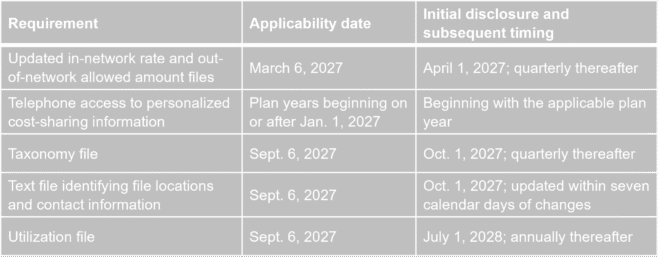
In separate implementation guidance, the Departments stated that they will begin developing technical specifications for prescription drug pricing files in November 2026, with the schema expected around May 2027. Plans and insurers are expected to begin publishing prescription drug files under that schema in December 2027 and monthly thereafter.
Employer Action Items
- Employers sponsoring non-grandfathered group health plans should coordinate with their insurers, third-party administrators, and other service providers to prepare for the updated requirements.
- Employers with self-insured plans should pay particular attention to contractual responsibilities for preparing, posting, and maintaining accurate machine-readable files.
- Until April 1, 2027, plans and insurers should continue complying with the existing In-network Rate and Allowed Amount File requirements using schema version 2.0. Plan sponsors should review their current transparency procedures, confirm that vendors are prepared to meet the applicable deadlines, and ensure participants can access required cost-sharing information. Although vendors may perform disclosure functions on behalf of a plan, employers should understand their plan’s continuing compliance responsibilities.
Compliance Question of the Month: ACA Affordability Calculation
- If an employer guarantees all full-time employees a minimum of 40 hours per week, can they use 40 hours per week when calculating ACA affordability, or would they still need to use 30 hours per week under the rate of pay safe harbor?
- The rate of pay safe harbor requires an assumed 130 hours per month, regardless of whether employees work more or are paid for more.
Answers to the Question of the Week are provided by Kutak Rock.


